
Which AI Agent Framework Should You Use in 2026? (The Decision Guide)
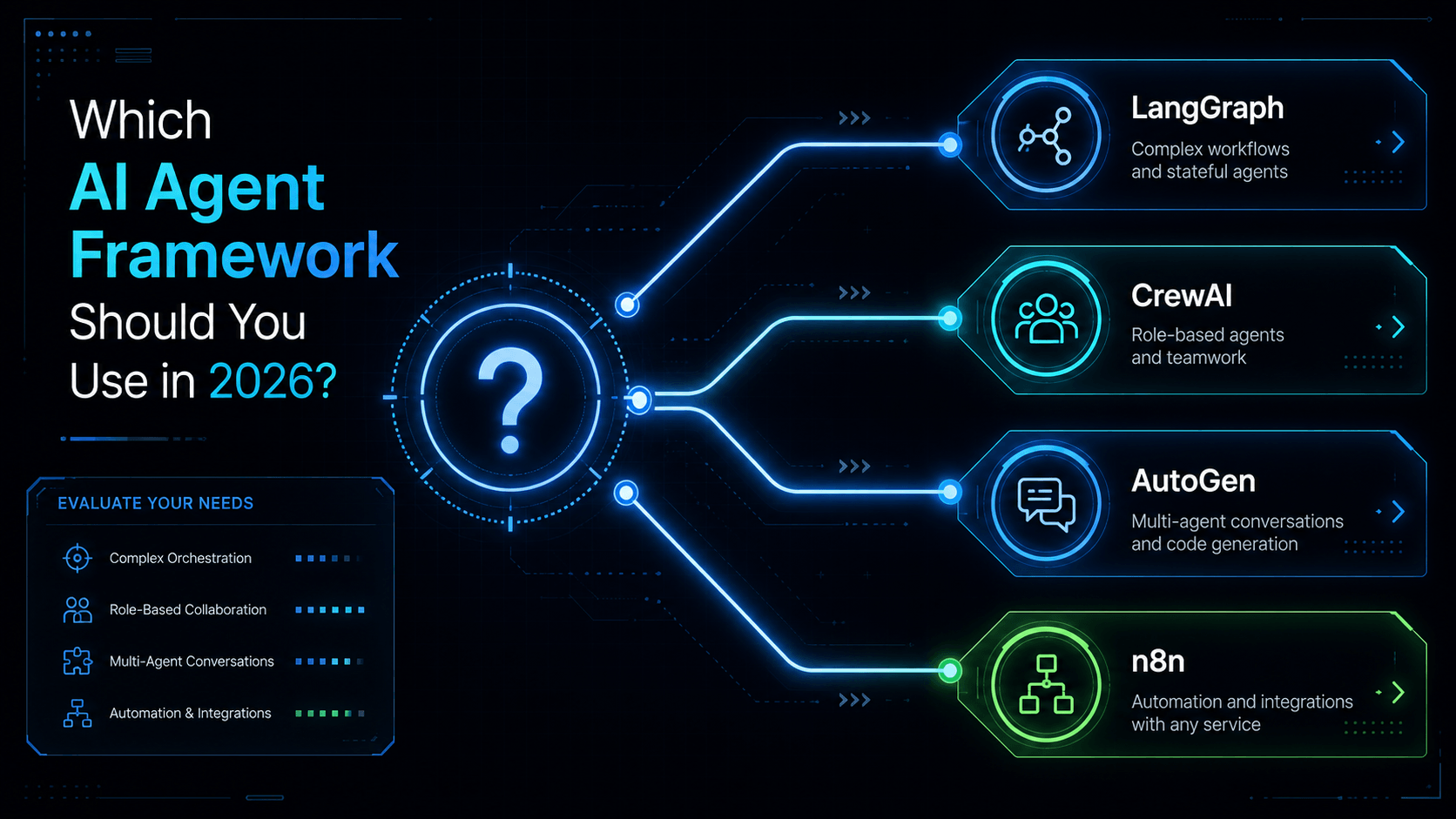
Everyone's building AI agents right now. And everyone hits the same wall five minutes in: which framework do I actually use?
The articles you'll find online give you the same recycled list - LangChain, CrewAI, AutoGen - with vague comparisons that don't help you make a decision. This guide is different. It's structured as a decision tree. Answer a few questions about your situation, and you'll know exactly which framework to pick - and more importantly, why.
No hype. No filler. Just the real tradeoffs, verified against what developers are actually shipping in 2026.
First: What Even Is an AI Agent Framework?
Before picking a framework, the framing matters.
An AI agent is not just a model. It's a model + a loop + tools + memory of what just happened. The framework manages all of that plumbing - calling the model with the right context, routing tool calls, handling errors, persisting state between steps, and knowing when to stop.
The difference between a good and bad framework choice isn't "which one demos better." It's what happens three months later when you hit production: testing, error recovery, state management, and debugging. That's where framework choices become painful or painless.
With that said - here's the decision tree.
The Decision Tree: Start Here
Question 1: Are you prototyping or building for production?
- Prototyping fast → go to Question 2
- Building something real that needs to scale → go to Question 3
Question 2: What's your workflow shape?
- Agents with clear roles working on a shared goal → CrewAI
- Multi-turn conversation between multiple agents → AutoGen / AG2
- Just need to wire up tools and test quickly → LangChain
Question 3: What's your primary model provider?
- You're committed to Claude (Anthropic) → Claude Agent SDK
- You're committed to OpenAI → OpenAI Agents SDK
- You need multi-provider flexibility → LangGraph
- You need complex state + human-in-the-loop + fault tolerance → LangGraph
Question 4: Are you non-technical or want visual automation without code?
- Yes → n8n (visual agent builder, zero-code option)
Framework-by-Framework Breakdown
Now that you know where you're landing, here's the full picture on each option.
LangGraph - Best for Production Complexity
Best if: You need fine-grained control, durable workflows, human-in-the-loop checkpoints, or fault-tolerant long-running agents.
Safe versions in 2026: LangGraph 0.4+
LangGraph is the serious production choice. It shipped its first stable major release (1.0) in October 2025, and 0.4 added stable checkpointing APIs and PostgreSQL persistence. It models your agent workflow as a directed graph - each node is a function, each edge is a conditional transition. This gives you explicit control over branching, state, and retry logic that the other frameworks simply don't have.
The architecture is the analogy from a widely-cited 2026 engineering post: LangChain gives you LEGO bricks. CrewAI gives you a crew and a mission briefing. AutoGen gives you the conversation itself. LangGraph gives you the blueprint and the factory floor.
What it does well:
- Built-in persistence - agents resume after failures without losing state
- Human-in-the-loop interrupts via the checkpointer API
- Parallel fan-out across multiple agent nodes
- Can be used standalone - you no longer need LangChain to use LangGraph
- Streaming for tool outputs (landed in 0.3.x)
What it doesn't do:
- Fast prototyping. The abstraction overhead is real. You'll spend more time upfront designing your graph.
- No native role-based coordination. If your workflow is "assign this to the researcher, that to the writer," CrewAI is cleaner.
Best if: Teams already in the LangChain ecosystem who need durability. Production deployments where an agent failure means lost business.
Affiliate note: LangSmith (LangChain's observability product) pairs with LangGraph and offers a free tier. Worth using if you go this route.
CrewAI - Best for Multi-Agent Role-Based Workflows
Best if: You have a clear workflow where different agents own different parts of the task and you need to move fast.
Safe versions in 2026: CrewAI 0.105+
CrewAI is built on top of LangChain, which means you get the LangChain tool ecosystem and integrations without rebuilding everything. But the layer CrewAI adds - role-based agents, Crews, Flows - makes it dramatically easier to structure collaborative agent workflows than raw LangChain.
The mental model is simple: you define a crew (a team of agents), assign each agent a role and set of tools, define the tasks, and CrewAI handles the orchestration. For pipeline-style workflows where the sequence is predictable, this is the fastest framework to ship with.
What it does well:
- Lowest barrier to entry of any production-grade framework
- Role + task structure forces you to think clearly about workflow design
- Parallel task execution built in
- Good for content pipelines, research workflows, data enrichment
- RAG memory support
- February 2026: added improved tool-call routing for Anthropic and Google models
What it doesn't do:
- Complex branching logic. LangGraph handles conditionals; CrewAI assumes more linear flow.
- Deep state control. If your agent needs to resume from a specific checkpoint after a crash, LangGraph is the right tool.
Real-world sweet spot: A "researcher + writer + editor" pipeline. A "data collector + analyzer + reporter" flow. Any workflow where you can describe the job as "Agent A does X, then passes to Agent B who does Y."
AutoGen / AG2 - Best for Conversational Multi-Agent Research
Best if: You need agents to debate, negotiate, or build consensus through dialogue.
Safe versions in 2026: AutoGen 1.0+
One important note for 2026: Microsoft has shifted AutoGen to maintenance mode in favor of the broader Microsoft Agent Framework. Active development continues under AG2 (the community fork), but if you're building something new for production, take this into account.
AutoGen's core innovation is treating agent coordination as a conversation. Agents participate in a group dialogue, and orchestration emerges from how they respond to each other. This makes it uniquely powerful for research simulations, debate-style reasoning, and scenarios where you genuinely don't want to pre-specify the workflow - you want agents to figure it out together.
What it does well:
- The most diverse conversation patterns of any framework (group chat, sequential dialogue, nested chat)
- Strong for research, academic simulation, and complex reasoning tasks
- Great if you're exploring agent behavior rather than shipping a fixed product
- AG2 community fork keeps active development going post-Microsoft maintenance mode
What it doesn't do:
- Production reliability at scale. The conversation metaphor is powerful for exploration but harder to govern in high-stakes deployments.
- Fine-grained state management. Not its architecture.
Real-world sweet spot: AI red-teaming, automated literature review, multi-agent debate for decision support, research pipelines where emergent behavior is a feature, not a bug.
Claude Agent SDK - Best for Claude-Native Production Agents
Best if: You're building on Claude models and want the cleanest integration with Anthropic-specific features.
The Claude Agent SDK is Anthropic's official framework for building agents on Claude. It launched in 2025 and has since passed AutoGen on production deployment count in enterprise telemetry (per the LangChain State of AI 2025 report). In 2026, Anthropic also launched Claude Managed Agents - a fully managed cloud runtime where Anthropic handles container orchestration, scaling, and session persistence.
Important pricing change (June 15, 2026): Claude Agent SDK usage no longer draws from standard subscription limits. It now consumes a separate monthly credit - $20 for Pro, $100 for Max 5x, $200 for Max 20x - billed at standard API rates. Plan accordingly.
What it does well:
- Deepest MCP (Model Context Protocol) integration of any framework - Anthropic co-created MCP
- Claude-specific features (extended thinking, prompt caching, computer use, memory primitives) wired in natively
- Context compaction for long-running tasks
- Cost controls via
max_budget_usdparameter per session - Managed hosting option removes all infrastructure burden
What it doesn't do:
- Multi-provider flexibility. This SDK exists to make Claude easy - not to abstract across models.
- Best-in-class for non-Claude workflows. If you're using GPT-4o or Gemini alongside Claude, LangGraph is more practical.
Real-world sweet spot: Coding agents, OS-level automation (native Bash, file I/O, subagent parallelism), long-running research agents where Claude's extended thinking mode adds genuine value.
OpenAI Agents SDK - Best for OpenAI-Native and Voice-First Products
Best if: You're all-in on OpenAI models and want explicit, clean multi-agent handoffs.
The OpenAI Agents SDK evolved from the experimental Swarm project into a production-grade framework. The April 2026 update added a model-native harness (file operations, code execution, shell access) and native sandboxing with support for seven cloud providers: E2B, Modal, Cloudflare, Daytona, Runloop, Vercel, and Blaxel.
What it does well:
- Strongest for voice-first products - native real-time audio agent support
- Explicit handoffs between agents (less emergent than AutoGen, more structured)
- Built-in guardrails and tracing
- Clean integration with ChatGPT Enterprise (SSO, audit logging, data residency)
- Multi-provider sandbox support after April 2026 update
What it doesn't do:
- Model flexibility. Like the Claude SDK, this is OpenAI-native.
- Deep state persistence comparable to LangGraph.
Real-world sweet spot: Customer-facing voice agents, sales automation on OpenAI infrastructure, teams already paying for ChatGPT Enterprise and wanting agent capabilities in the same ecosystem.
n8n - Best for No-Code / Low-Code Agent Automation
Best if: You're a non-developer, a business owner, or a developer who wants to build agent workflows without writing framework boilerplate.
n8n is the most underrated option in this list for a specific audience: people who need to ship AI agent workflows fast without deep Python/TypeScript expertise. The AI Agent node in n8n lets you build tool-calling, memory-enabled agents using a visual editor - drag nodes, connect them, define logic.
2026 pricing reality:
- Self-hosted Community Edition: Free forever. Unlimited executions. Full access to 500+ integrations. AI nodes included. You pay only for LLM API costs (typically $0.001–$0.03 per run).
- Cloud Starter: ~$24/month
- Cloud Pro: ~$50/month
- No separate AI pricing tier - AI agent workflows count as regular executions
What it does well:
- Visual workflow builder - no framework boilerplate
- 500+ native integrations (Slack, Notion, Airtable, Gmail, CRMs, databases)
- AI Agent node supports OpenAI, Anthropic Claude, Google Gemini, Groq, and local models via Ollama
- Self-hosting with Ollama + local LLaMA = effectively $0/token after infrastructure
- Execution-based billing makes it 10–20x cheaper than Zapier for complex multi-step workflows
- Developers switched LangChain agents to n8n and cut build time from ~10 hours to ~1 hour per agent
What it doesn't do:
- Custom agent architectures that require novel reasoning patterns. You're constrained to the node paradigm.
- Complex state graph management. For deeply custom production agents, LangGraph is more powerful.
→ Try n8n's self-hosted edition for free Free forever on self-hosted. No credit card required.
The Honest Comparison Table
| Framework | Best For | Prototyping Speed | Production Readiness | Multi-Model | Code Required |
|---|---|---|---|---|---|
| LangGraph | Complex stateful production agents | Slow | ⭐⭐⭐⭐⭐ | Yes | Yes |
| CrewAI | Role-based team workflows | Fast | ⭐⭐⭐⭐ | Yes (via LangChain) | Yes |
| AutoGen / AG2 | Conversational multi-agent research | Medium | ⭐⭐⭐ | Yes | Yes |
| Claude Agent SDK | Claude-native agents, OS automation | Medium | ⭐⭐⭐⭐ | No (Claude only) | Yes |
| OpenAI Agents SDK | OpenAI-native, voice-first | Medium | ⭐⭐⭐⭐ | No (OpenAI only) | Yes |
| n8n | Visual automation, business workflows | Very Fast | ⭐⭐⭐⭐ | Yes | Optional |
5 Real Scenarios - What to Actually Pick
Scenario 1: "I'm a solo developer building a research assistant that reads papers and writes summaries." → CrewAI. Define a Researcher agent and a Writer agent. Ship in a day. Upgrade to LangGraph if you need persistence later.
Scenario 2: "I'm at a startup building a customer support agent that needs to handle 10,000 conversations/day and recover from failures without losing context." → LangGraph. You need checkpointing, state persistence, and fault tolerance. The upfront design cost pays off at scale.
Scenario 3: "I'm a marketing agency owner who wants to automate lead enrichment - pull new leads from a form, enrich with LinkedIn data, score them, and post to Slack." → n8n. No code needed. Connects every tool you already use. Done in an afternoon. Try it free →
Scenario 4: "I'm building an AI coding assistant that operates on a full codebase, runs Bash commands, and submits PRs autonomously." → Claude Agent SDK. Native Bash, file I/O, subagent parallelism - exactly what this use case needs. Deepest MCP integration for connecting to GitHub and other tools.
Scenario 5: "I want multiple agents to debate the pros and cons of a business decision and give me a synthesis." → AutoGen / AG2. The conversational multi-agent pattern is built for this. No other framework handles emergent group dialogue as naturally.
What to Avoid in 2026
Don't build on AutoGen (Microsoft's version) as your production foundation. Microsoft shifted it to maintenance mode. AG2 (community fork) is the actively developed path forward.
Don't use raw LangChain for complex agentic workflows. LangChain is great for LLM application scaffolding, but for agents specifically, LangGraph is the right layer. They're complementary, not interchangeable.
Don't pick a vendor-native SDK (Claude or OpenAI) if you want model flexibility. They exist to make one provider's features easy - not to abstract across the market.
Don't over-engineer with LangGraph if you're still in week one. Start with CrewAI or n8n, prove the workflow works, then migrate to LangGraph when you hit the limits of simpler frameworks.
The Versions That Are Safe to Build On (June 2026)
If you're auditing dependencies today, here are the minimum stable versions:
- LangGraph: 0.4+
- CrewAI: 0.105+
- AutoGen / AG2: 1.0+
- n8n: Cloud or self-hosted Community Edition (both current)
- Claude Agent SDK: Current (check Anthropic docs for latest)
- OpenAI Agents SDK: Current (April 2026 update or later)
Anything older than these is missing checkpointing, observability, or API support that you'll want within six months.
One More Thing: Compare the Models Powering These Frameworks
Most of these frameworks support multiple underlying LLMs - GPT-4o, Claude, Gemini, Llama, and more. The framework choice and the model choice are separate decisions.
If you want to compare context windows, pricing, benchmarks, and capabilities across all major models before you commit, use the AI Model Comparator → - it's free and runs entirely in your browser.
Quick Decision Summary
| If you are... | Use this |
|---|---|
| Building a production agent that needs fault tolerance | LangGraph |
| Running a team of agents with clear roles | CrewAI |
| Simulating multi-agent debate or research | AutoGen / AG2 |
| Going all-in on Claude models | Claude Agent SDK |
| Going all-in on OpenAI models + voice | OpenAI Agents SDK |
| Non-technical or want to move fast without code | n8n |
The space moves fast. But the questions that determine the right framework - workflow complexity, model commitment, production requirements, and team expertise - don't change that quickly. Start with those, and the choice becomes obvious.
Found this useful? ReverseToolkit also has a free AI Model Comparator that shows current pricing, context windows, and benchmarks for every major model - useful when you're deciding which LLM to power your agent with.